
A modern player for sampled instruments

Download Rhapsody v3.3.0
Linux

- Debian 11+
- Disk 100MB
- CPU: Intel/AMD
- Format: VST3
macOS

- macOS 10.14+
- Disk 100MB
- CPU: Intel/Apple Silicon
- Format: VST3, AU, AAX
Windows

- Windows 7+
- Disk 100MB
- CPU: Intel/AMD
- Format: VST3, AAX
Getting Started
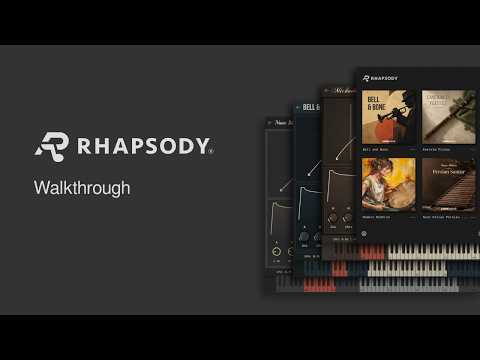
Follow this quick video to get up and running. You can also read the Getting Started guide for more detailed instructions.
1. Install Rhapsody
Download and run the installer for your OS. On Linux, make it executable, then launch it from the terminal.
2. Install a Library
Download an installation package from your account. Then in Rhapsody, click the + button and follow the on-screen instructions.
Frequently Asked Questions
Is Rhapsody open source?
Yes. Rhapsody is released under the GNU GPL. Click here to visit the git repository.
The Rhapsody name and logo are registered trademarks. If you fork Rhapsody for your own derivative work you will need to give it a new name and logo.
What is a Rhapsody library?
Libraries contain one or more virtual instrument patches that can be loaded by Rhapsody.
They are created by recording notes on a real instrument. The number of recordings varies depending on the requirements of the library. Some are constructed from just a few, while others contain many thousands.
These recordings are then chopped up into individual files, called samples, which are loaded into Rhapsody so that they can be triggered using MIDI.
How can I create my own Rhapsody library?
Rhapsody libraries are built using HISE. You should understand the basic HISE workflow before creating libraries for Rhapsody. A complete and free beginner course for HISE is available at AudioDevSchool.
The simplest way to construct Rhapsody libraries is to use the Rhapsodist framework. This is a collection of templates and tools that I’ve developed for creating libraries.
Detailed documentation for Rhapsodist is available here. I also post tutorials to my YouTube channel.
What are the .hr1, files, and how do I use them?
Rhapsody libraries are supplied as one or more .hr files. Smaller instruments are usually a single .hr1 file. Larger instruments may be split across several files, such as .hr1, .hr2, .hr3, and so on.
Make sure to download all of the package files for the instrument you’re installing and place them all in the same folder.
These files can be deleted after the library has been installed.
Can I store my sample libraries on an external SSD?
Yes. During installation you will be asked where you want to install the samples. You can choose different locations for each library.
If you move the samples to a new location after installation, you’ll need to use the relocate feature in Rhapsody so it can find them.
Can I use my libraries on multiple computers?
Yes. Rhapsody does not impose any DRM restrictions. You can install your libraries on as many computers as you like.
Can I use Rhapsody libraries in commercial work?
Yes absolutely! For full details please see the software license.
Is Rhapsody Apple silicon native?
Yes, Rhapsody Player will run natively on both Intel and Apple Silicon systems.
Does Rhapsody work in Pro Tools?
Yes. Rhapsody is available as an AAX plugin for use in Pro Tools on Windows and macOS.
Does Rhapsody work in FL Studio?
Yes, but FL Studio occasionally brings up unique issues.
If you run into any problems in FL Studio there are three things you can try straight away.
- Make sure you are using an audio buffer size that is a power of two: 64, 128, 256, 512, 1024, etc.
- Click the cog icon in the FL Studio’s Rhapsody window header. Select the troubleshooting tab. Enable the “Use fixed size buffers” option.
- Enable FL Studio’s align tick lengths option. You can find this in Options > Audio Settings > CPU > Align Tick Lengths.
If you’re still having problems with Rhapsody Player in FL Studio please contact me and I’ll do what I can to get you up and running.
Where can I get more Rhapsody libraries?
Libre Wave is the main source of Rhapsody instruments. However the player is open to any developer and we are now starting to see third-party Rhapsody instruments becoming available.
Here are some free ones: Layer Engine, Open Strings, Reso Piano.
You can also purchase Libre Wave instruments from some third-party resellers.
Do Rhapsody libraries need a license key?
When you purchase a library from Libre Wave you might be issued with a license key. This is only used to provide access to downloadable files and keep track of purchases.
The license key is not needed inside Rhapsody itself and you don’t need to register it anywhere. Rhapsody does not include any form of DRM.