Modern Bodhrán
A contemporary bodhrán library for authentic Celtic percussion.
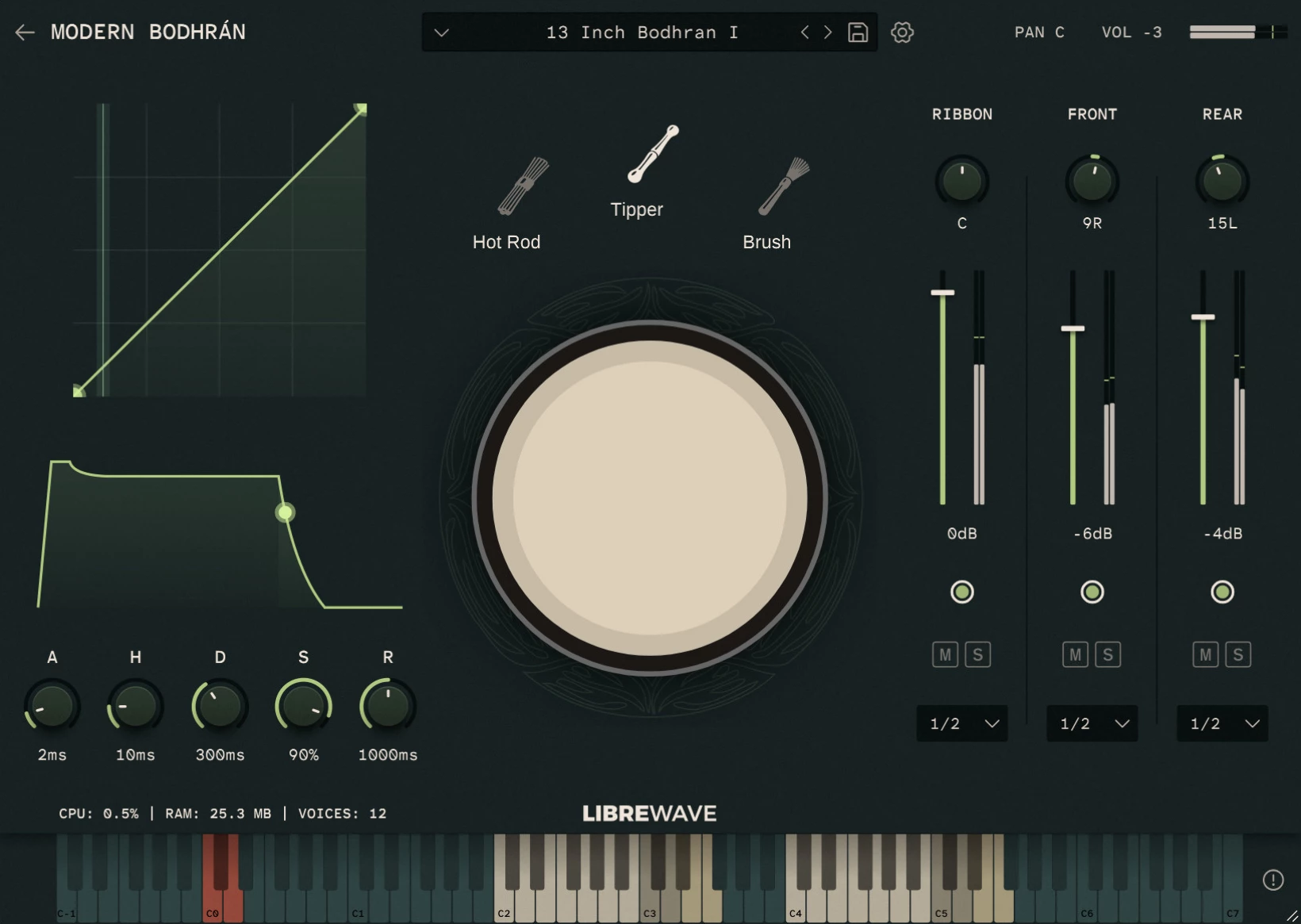
Modern Bodhrán brings the traditional Celtic frame drum into a contemporary music landscape.
The library includes four unique bodhráns, each with its own distinctive sound and character.
For each drum, we recorded five unique tones, played with three different sticks at three dynamic levels. Each tone was captured with five microphones, including separate up and down strokes, with six repetitions of each.
That gives you 36 recorded variations for every tone, providing plenty of natural variation and making repeated notes sound organic.
The 2000+ samples in this library were beautifully performed by Marissa Waite and recorded at Gran’s House Studio in Scotland.
Videos


Audio Demos
About the Drums
Modern Bodhrán is a traditional Celtic percussion library featuring four unique drums. These instruments have been hand built by master craftsmen.
Bodhrán 1: 16″
Built by Seamus O’Kane in Ireland in 2005. It’s made with lambeg skin and has 8 standard tuners on the inside of the rim, which can be manipulated using a screwdriver. This is quite a big drum with a 16″ frame. It has a beautiful smooth tone with a huge range. The tones have a really clear and soft quality, with a booming low end and a very high and striking top end.
Bodhrán 2: 14″
A wonderful bodhrán made by Christian Hedwitschak, based in Germany. He crafts beautiful bodhráns, that are some of the most sought after and revered in the bodhrán playing community. The model we sampled is the Martin O’Neill Signature line, made in 2014. This is a slightly smaller drum at 14″ with a depth of 6″. It has a beautiful skin with a wide variety of tones that gives a very balanced sound across the whole range of the drum.
Bodhrán 3: 13″
Built in 2007 by Steve Forman. Steve is a fantastic and highly respected percussionist based in LA who relocated to Scotland. This bodhrán is one he made as part of his Tambourine Studios Bodhrán collection. This bodhrán is made with a premium natural rawhide goatskin, on a 13″ all-maple Keller cylinder frame. It has a large tonal span and a slightly ‘harder’ quality to the skin
Bodhrán 4: 13″
Crafted by John Wilson of Skye Bodhráns in 2009/2010. Another of the more modern style bodhráns with a deep rim and smaller 13″ frame. It has quite a wide range of tones and responds nicely under a mic and live. It also gives a good range of volume and responds well to the strength with which you strike the skin. As is common for many bodhráns made around this time, it is a more comfortable drum to play with its diameter and depth, but not as big a range tonally as one of Seamus O’Kane’s.
Highlights
4 Unique Drums
Each with it’s own history and sonic character.
Sticks & Strokes
6 Separate down and upstrokes for each drum, recorded with 3 different sticks.
3 Microphones
The on-screen mixer provides complete control over the mics.
36 Variations
A huge range of variations thanks to the number of dynamics, sticks, strokes, and round robins.
MIDI Loops
22 MIDI loops with handwritten notation to get you started.
Modern Studio Sound
Recorded at Gran’s House studio in the Scottish Uplands.
What’s Included
The bodhrán can produce a wide range of tones depending on where the musician’s hand is positioned inside the drum. We captured five different hand positions for each drum, plus rim shots, using three different sticks, three dynamic levels, and six repetitions of both up and down strokes.
This gives you 36 variations for every tone, providing plenty of natural variation for realistic performances.
The drum graphic on the interface displays a hand icon showing where Marissa’s hand was positioned inside the drum for each tone.
Keyboard Mapping
Up and down strokes are mapped to separate regions of the keyboard, allowing you to choose the stroke direction for each note.
You can also switch between the three sticks in real time using keyswitches.
Microphones
Every performance was recorded with five microphones. Two were positioned at the rear of the drum and two at the front. A ribbon microphone was also used to add warmth and character to the overall sound, giving you another option in the mix.
The on-screen mixer provides three channels for mixing the mono ribbon microphone, front stereo pair, and rear stereo pair.
MIDI Loops
Modern Bodhrán includes 22 MIDI loops for you to drop in to your sessions. The selection includes grooves, reels, jigs, and slip jigs.
Tech Specs
| Format | Rhapsody Player |
| Samples | 2232 @ 24-bit / 48kHz |
| Size (Installed) | 2.6GB |
| Instruments | 4 |
| Variations | 36 |
Rhapsody Player

Built for the free Rhapsody Player. Runs on Windows, macOS, and Linux.